Rock Academy
San Diego · San Diego County · Religious-affiliated
Compare with peers
Other schools in San Diego County, closest in size
Calvin Christian High School → Ocean View Christian Academy → Cambridge School → Victory Christian Academy → Horizon Prep → Compare all similar →Where grads go — and what it costs & pays
UC admits by campus · Class of 2025
Getting in is step one. The cost above is the average aid-receiving family's net price — yours depends on whether you qualify for aid — and your child's odds depend on their GPA + scores. See your family's real numbers at these campuses:
Get my child's odds + our real costs →Sources: UC Office of the President (admits); IPEDS net price + College Scorecard 10-yr earnings (cost & payoff). Full campus-by-campus breakdown below.
How Rock Academy compares for families
Real college outcomes data available below.
- ▸ StatewideUC Reach Score of 8 — 11 points below the California median of 19.
- ▸ vs Similar SchoolsOther schools in the county, closest in size: Calvin Christian High School, Ocean View Christian Academy, Cambridge School and 2 more. See the sidebar to compare side-by-side.
For Parents
Get alerts when Rock Academy's numbers change
New admissions results, enrollment shifts, test scores — a few alerts a year, no spam. Your email also saves your list across devices.
Objective, government-grade data — no school pays us for placement.
No SBAC data for private schools — and that's not the metric you want anyway
California's Smarter Balanced (CAASPP) assessment is administered by the state, by statute, to public & charter schools only. Private schools don't sit for it. That's why the SBAC card is missing on this profile — not a data gap on our side, a deliberate scope of the state's testing program.
For private schools, UC Reach is the stronger academic signal anyway. SBAC measures grade-11 inputs (proficiency on a state standard); UC Reach measures outputs (who actually got into the most selective UCs). For private-school families weighing tuition against college outcomes, the outputs are the relevant signal.
Scroll up to the UC Reach card for Rock Academy's 2025 number, statewide percentile, and 5-year trend.
Enrollment trend & projection
If this trend holds (+12.6%/yr, Total enrollment)
At tuition of $ / student:
| Horizon | Projected Total enrollment | Change | Tuition impact / yr |
|---|---|---|---|
| 1 yr (2026) | ~491 | +55 | $0 |
| 3 yr (2028) | ~623 | +187 | $0 |
| 5 yr (2030) | ~790 | +354 | $0 |
Straight-line extrapolation of the recent annual rate — a what-if, not a forecast of intent. Default = a wide range — Jewish day $25k–35k, Lutheran/Christian $10k–18k. Edit the figure to match your school.
Rock Academy sent 32 applications to the six most selective University of California campuses and 9.4% were admitted, producing a UC Reach Score of 8 (top-6 UC admits per 100 seniors, counting a student at each campus that admitted them) — 11 points below the California median of 19, higher than 11% of California high schools..
19
53
8
Higher than 11% of California high schools (1107 ranked, ≥50 seniors)
Rock Academy's UC Reach Score of 8 is below the California median (19). The top 10% of CA schools achieve 53 or higher.
Overall, Rock Academy's UC Reach is higher than 11% of California high schools (1107 ranked).
Private-school figures come from the California Private School Affidavit. Per CDE, inclusion in private-school data is not an evaluation, approval, or endorsement of a school.
GPA figures reflect 2024 — UC has not yet released applicant/admit GPA for 2025.
UC Outcomes Trend — 2019–2025
Class size from CDE grade 12 enrollment. Campus-level data: applicant and admit totals count a student once at EACH campus. A senior admitted to UCLA and UC San Diego adds 2 to the admit total, so the total can exceed the senior class — that is the metric working as defined, not an error. The admit RATE is unaffected: both its numerator and denominator are campus-level.
Campus Breakdown — 2025
| Campus | Applicants | Admits | Enrollees | Admit Rate | UC Reach Score | Yield | Avg GPA (App) '24 | Avg GPA (Adm) '24 |
|---|---|---|---|---|---|---|---|---|
| UCLA → Elite | 5 | —† | —† | —† | —† | — | 4.11 | —† |
| UC San Diego → Selective | 10 | 3 | 3 | 30.0% | 8 | 100.0% | 4.11 | —† |
| UC Santa Barbara → Selective | 6 | —† | —† | —† | —† | — | — | —† |
| UC Irvine → Selective | 6 | —† | —† | —† | —† | — | — | —† |
| UC Davis → | 5 | —† | —† | —† | —† | — | — | —† |
What This Means
Related reading
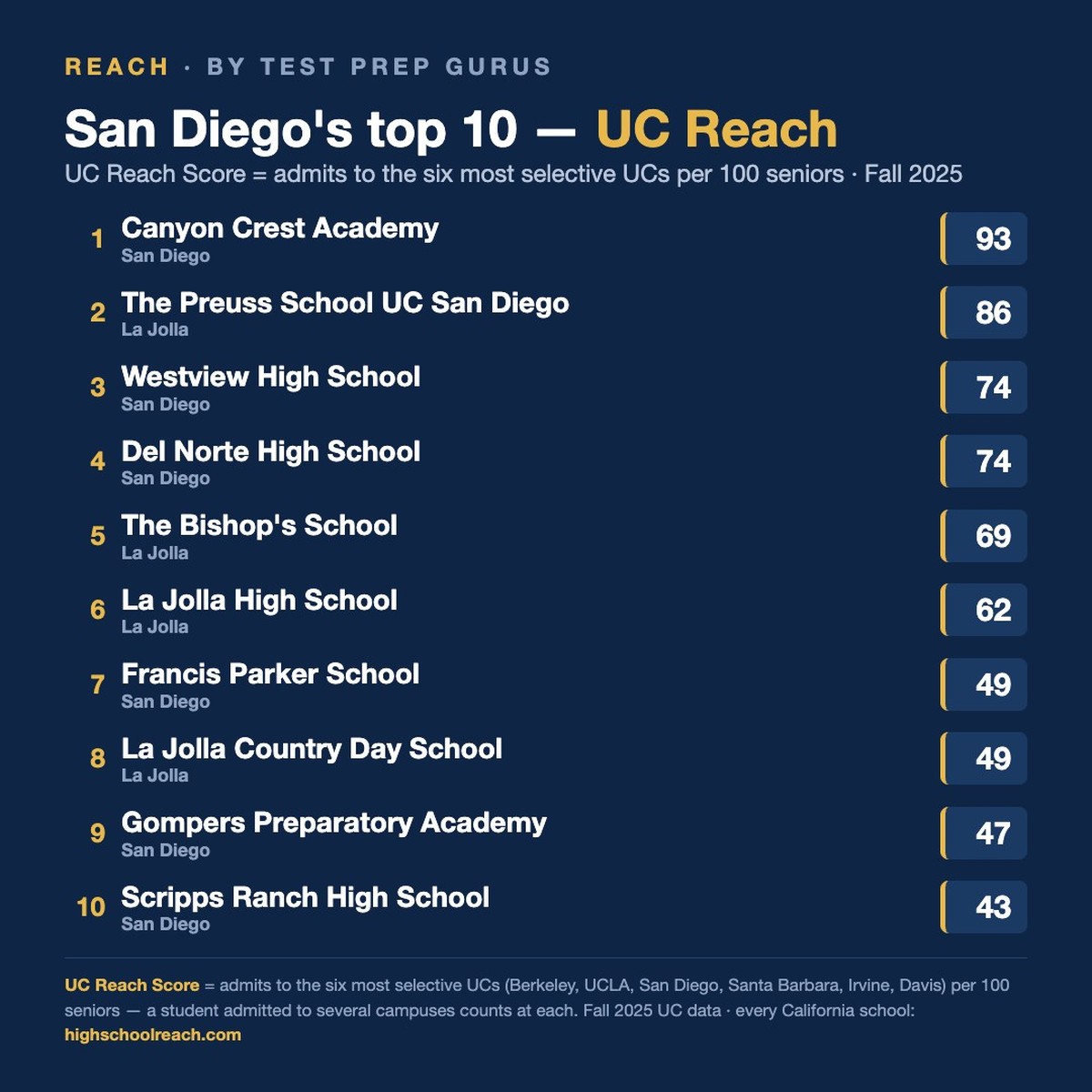
San Diego · League table · August 9, 2026
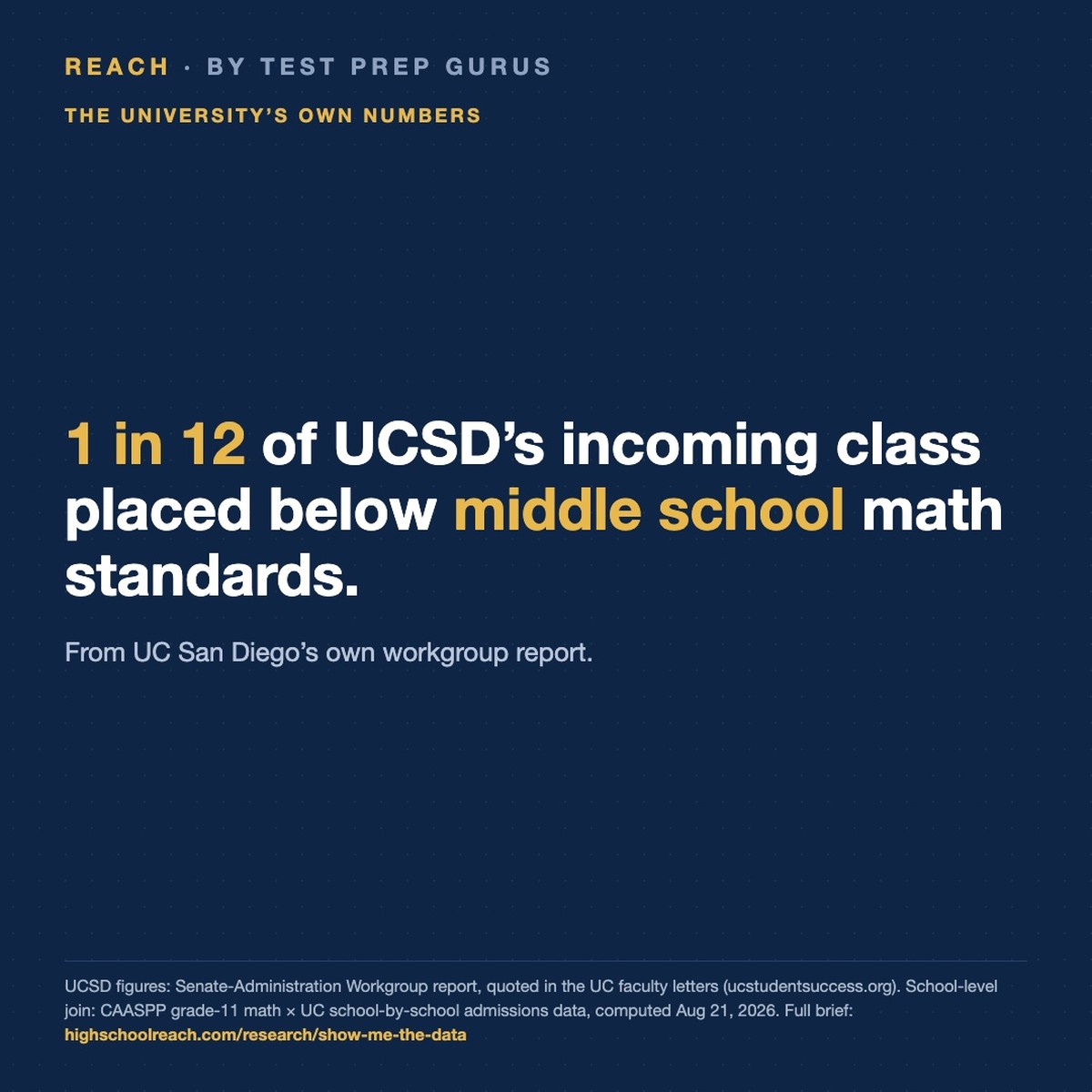
UC testing review · August 25, 2026