School Social Justice-Continuation Learn Center
Los Angeles · Los Angeles County · Public
A parent's read
- 3 in 4 graduates leave eligible for UC and CSU. 72% finish the A-G courses California's universities require before a student can even apply — most California schools manage about 6 in 10.
- Most grads aim beyond the UC system. Seniors file only ~0.7 UC applications each — families here mostly target CSU, private, or out-of-state colleges, so judge this school on more than its UC numbers.
- Worth asking about: attendance. 36% of students are chronically absent — above the state's ~23%. Ask what the school is doing about engagement; absenteeism is usually the earliest warning light.
Composed from this page's data — every claim is backed by a number in the sections below.
Where grads go — and what it costs & pays
UC admits by campus · Class of 2025
Getting in is step one. The cost above is the average aid-receiving family's net price — yours depends on whether you qualify for aid — and your child's odds depend on their GPA + scores. See your family's real numbers at these campuses:
Get my child's odds + our real costs →Sources: UC Office of the President (admits); IPEDS net price + College Scorecard 10-yr earnings (cost & payoff). Full campus-by-campus breakdown below.
How School Social Justice-Continuation Learn Center compares for families
Real college outcomes data available below.
- ▸ StatewideUC Reach Score of 13 — 6 points below the California median of 19.
- ▸ vs Similar SchoolsTrails the peer median (UC Reach Score 13 vs a 23 median) across the 5 most similar nearby schools.
For Parents
Get alerts when School Social Justice-Continuation Learn Center's numbers change
New admissions results, enrollment shifts, test scores — a few alerts a year, no spam. Your email also saves your list across devices.
Objective, government-grade data — no school pays us for placement.
SBAC academic outcomes — grade 11, 2025
Share of grade-11 students meeting or exceeding the California standard on Smarter Balanced ELA and Math. This is the academic-readiness signal that pairs with UC Reach (post-grad outcomes), stability (retention), and absenteeism (engagement). Note: statewide median Math is only ~20% — a school at 20% isn't an outlier; one at 45%+ genuinely is.
Source: California Assessment of Student Performance and Progress (CAASPP) Smarter Balanced research files. Benchmarks limited to non-virtual public & charter HS with ≥30 tested students.
Student composition — 2025-26
HS grades 9–12 racial/ethnic composition and program subgroups, from CDE Census Day Enrollment. Two-year shift shown when ≥1 pt — surfaces how the community served has changed since 2023-24.
Race / ethnicity
Program subgroups
Source: California Department of Education, Census Day Enrollment 2025-26 (HS grades 9–12). Δ shown when shift is ≥1 pt since 2023-24. Categories below 0.5% omitted.
Chronic absenteeism — 2024-25
Share of students missing 10% or more of expected attendance — the leading indicator that often precedes the demand decline shown above. Families disengaging tend to raise absenteeism first, then formally leave. Basis: grades 9–12.
Absenteeism is up 4.5 pp since 2016-17. A rising absenteeism trend often precedes formal departure — worth investigating which subgroups are driving it.
Source: California Department of Education, Chronic Absenteeism 2024-25. Benchmarks limited to non-virtual public & charter HS with ≥100 eligible students. CDE didn't publish a usable 2019-20 file (COVID).
Enrollment trend & projection
If this trend holds (-10.1%/yr, Total enrollment)
At per-pupil funding of $ / student:
| Horizon | Projected Total enrollment | Change | Funding impact / yr |
|---|---|---|---|
| 1 yr (2027) | ~259 | -29 | $0 |
| 3 yr (2029) | ~210 | -78 | $0 |
| 5 yr (2031) | ~170 | -118 | $0 |
Straight-line extrapolation of the recent annual rate — a what-if, not a forecast of intent. Default = California's LCFF base grant for grades 9–12 ($12,423/ADA). Edit the figure to match your school.
How does School Social Justice-Continuation Learn Center really compare on getting kids to college?
We've ranked it #7 of 8 most similar nearby schools on UC Reach. Unlock the full snapshot to see the head-to-head — who's ahead, by how much, and where it's heading.
Your similar-school group includes
Early College Academy-La Trade Tech College · Joseph Pomeroy Widney Career Preparatory And Transition Center · Matrix For Success Academy · Academic Leadership Community · Alliance Smidt Technology High · East College Prep · +4 more
Enrollment stability & demand — 2024-25
Two complementary signals: retention (do students stay once enrolled?) and demand (are families choosing the school?). Read against the Los Angeles County baseline — the demographic tide is moving every CA HS, so a school's gap vs. county is the actionable signal.
Enrollment growth is beating Los Angeles County (+11.7% vs. -12.0%), but 79 of 385 students didn't maintain continuous enrollment. Why are families leaving once enrolled? Chronic absenteeism is also at 35.5% (up +4.5 pts from 2016-17) — engagement and demand are both signaling decline.
79 of 385 students who enrolled at School Social Justice-Continuation Learn Center this year didn't maintain continuous enrollment (20.5% non-stability). Mid-year transfers, dropouts, and other exits are all counted.
Stability by student group
Nearest peer high schools
Source: California Department of Education, Stability Rate 2024-25. Benchmarks limited to non-virtual public & charter HS with ≥100 cumulative enrollees so by-design-high-churn continuation schools don't dominate the bottom of the distribution. Cumulative enrollment counts every student on the rolls during the year, so it can exceed peak-day enrollment.
School Social Justice-Continuation Learn Center sent 53 applications to the six most selective University of California campuses and 18.9% were admitted, producing a UC Reach Score of 13 (top-6 UC admits per 100 seniors, counting a student at each campus that admitted them) — 6 points below the California median of 19, higher than 30% of California high schools. The school produces 5.2 UCLA + UC Berkeley admits per 100 seniors.
19
53
13
Higher than 30% of California high schools (1107 ranked, ≥50 seniors)
School Social Justice-Continuation Learn Center's UC Reach Score of 13 is below the California median (19). The top 10% of CA schools achieve 53 or higher.
But in Los Angeles County, where the local median is 25 and the top-10% bar is 56, this score is mid-pack rather than exceptional — typical of its market rather than a standout.
Overall, School Social Justice-Continuation Learn Center's UC Reach is higher than 30% of California high schools (1107 ranked).
UC funnel — which kids are getting in at what GPA
Combining the school's applicant pool GPA, admit pool GPA, actual admit rate, and statewide CA admit rates by individual GPA band, we can read which GPA tiers tend to get in — and which don't.
| Campus | 4.00+ GPA | 3.70–3.99 GPA | 3.30–3.69 GPA | < 3.30 GPA |
|---|---|---|---|---|
| UC San Diego | Strong shot | Moderate | Long odds | Filtered out |
| UC Davis | Strong shot | Strong shot | Real shot | Filtered out |
The numbers behind it
| Campus | Applicant GPA | Admit GPA | Lift ⓘ | Admit rate | vs peer schools @ same GPA ⓘ |
|---|---|---|---|---|---|
| UC San Diego (2022) | 3.24 | 3.88 | +0.64 | 24.0% | — |
| UC Davis (2020) | 3.39 | 4.05 | +0.66 | 35.7% | Peers +0.51 · steeper |
Statewide CA admit rates by individual GPA band, 2025 (for reference)
| GPA band | UCB | UCLA | UCSD | UCSB | UCI | UCD |
|---|---|---|---|---|---|---|
| 4.00+ | 17.0% | 15.1% | 45.2% | 62.3% | 46.3% | 65.9% |
| 3.70–3.99 | 3.1% | 1.6% | 9.3% | 17.6% | 17.0% | 31.1% |
| 3.30–3.69 | 0.8% | 0.5% | 1.5% | 2.8% | 2.4% | 10.3% |
| 3.00–3.29 | 0.4% | 0.3% | 0.2% | 0.4% | 0.3% | 1.9% |
| < 3.00 | 0.7% | 0.4% | 0.3% | 0.2% | 0.1% | 0.7% |
UC Outcomes Trend — 2018–2025
Class size from CDE grade 12 enrollment. Campus-level data: applicant and admit totals count a student once at EACH campus. A senior admitted to UCLA and UC San Diego adds 2 to the admit total, so the total can exceed the senior class — that is the metric working as defined, not an error. The admit RATE is unaffected: both its numerator and denominator are campus-level.
Campus Breakdown — 2025
| Campus | Applicants | Admits | Enrollees | Admit Rate | UC Reach Score | Yield | Avg GPA (App) | Avg GPA (Adm) |
|---|---|---|---|---|---|---|---|---|
| UC Berkeley → Elite | 7 | —† | —† | —† | —† | — | 3.01 | —† |
| UCLA → Elite | 12 | 4 | 3 | 33.3% | 5 | 75.0% | 3.34 | —† |
| UC San Diego → Selective | 5 | 3 | —† | 60.0% | 4 | — | 3.71 | —† |
| UC Santa Barbara → Selective | 11 | 3 | —† | 27.3% | 4 | — | 3.18 | —† |
| UC Irvine → Selective | 12 | —† | —† | —† | —† | — | 3.04 | —† |
| UC Davis → | 6 | —† | —† | —† | —† | — | 2.04 | —† |
What This Means
For School Admins
The full Reach Report for School Social Justice-Continuation Learn Center
A board- and LCAP-ready intelligence brief: your enrollment retention and college outcomes, benchmarked against your closest competitors, with a 5-year forecast, concrete steps to act on, and the rigor + outcomes story you can share with your families. Built from primary public data — prepared for you, not auto-generated.
- ✓Your UC Reach Score (13) ranked head-to-head against your closest competitor schools
- ✓Your 5-year enrollment forecast (currently -10.1%/yr) with the revenue at stake
- ✓Student-retention benchmarking vs your county median — and the LCAP evidence to back your goals
Related reading
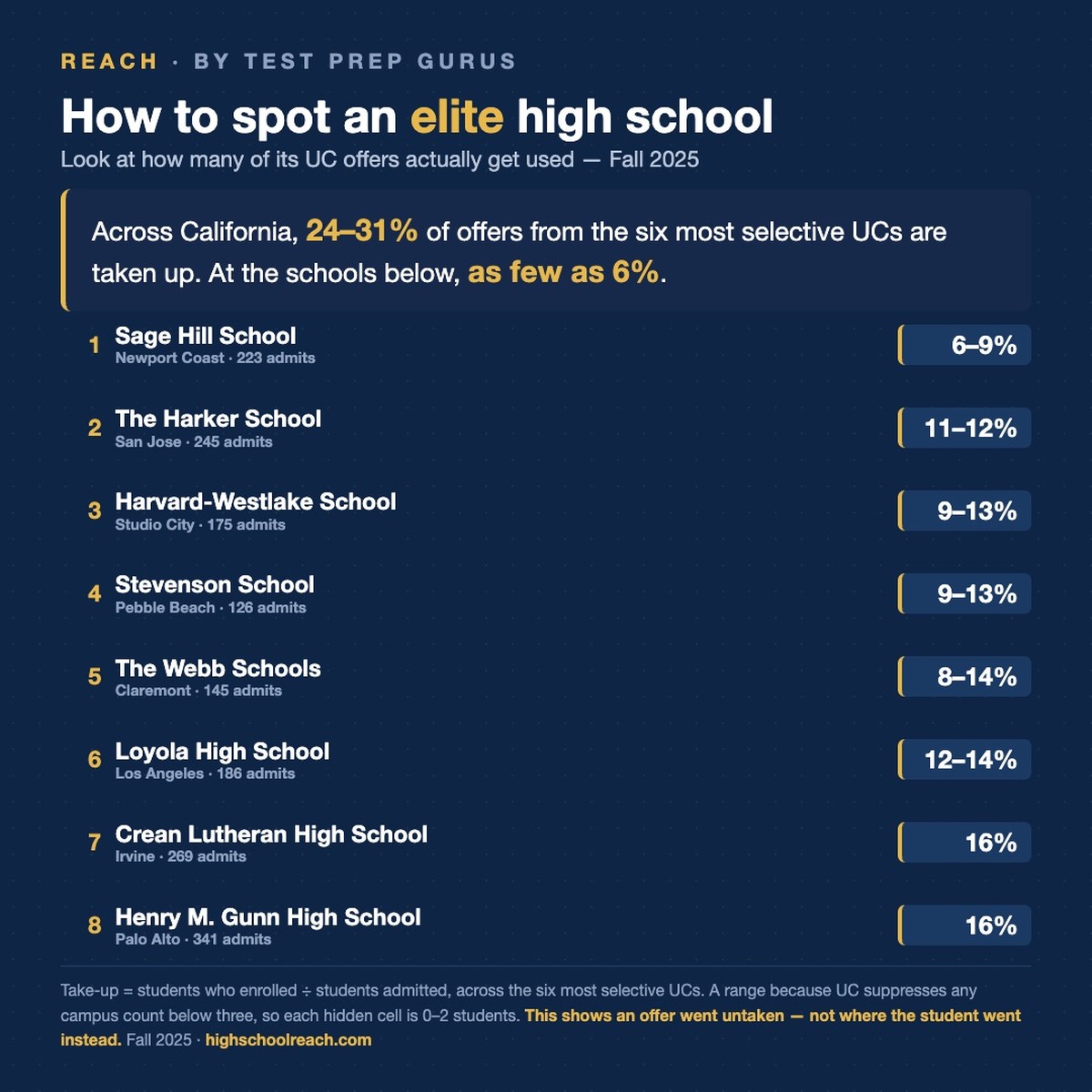
Behind the data · August 24, 2026
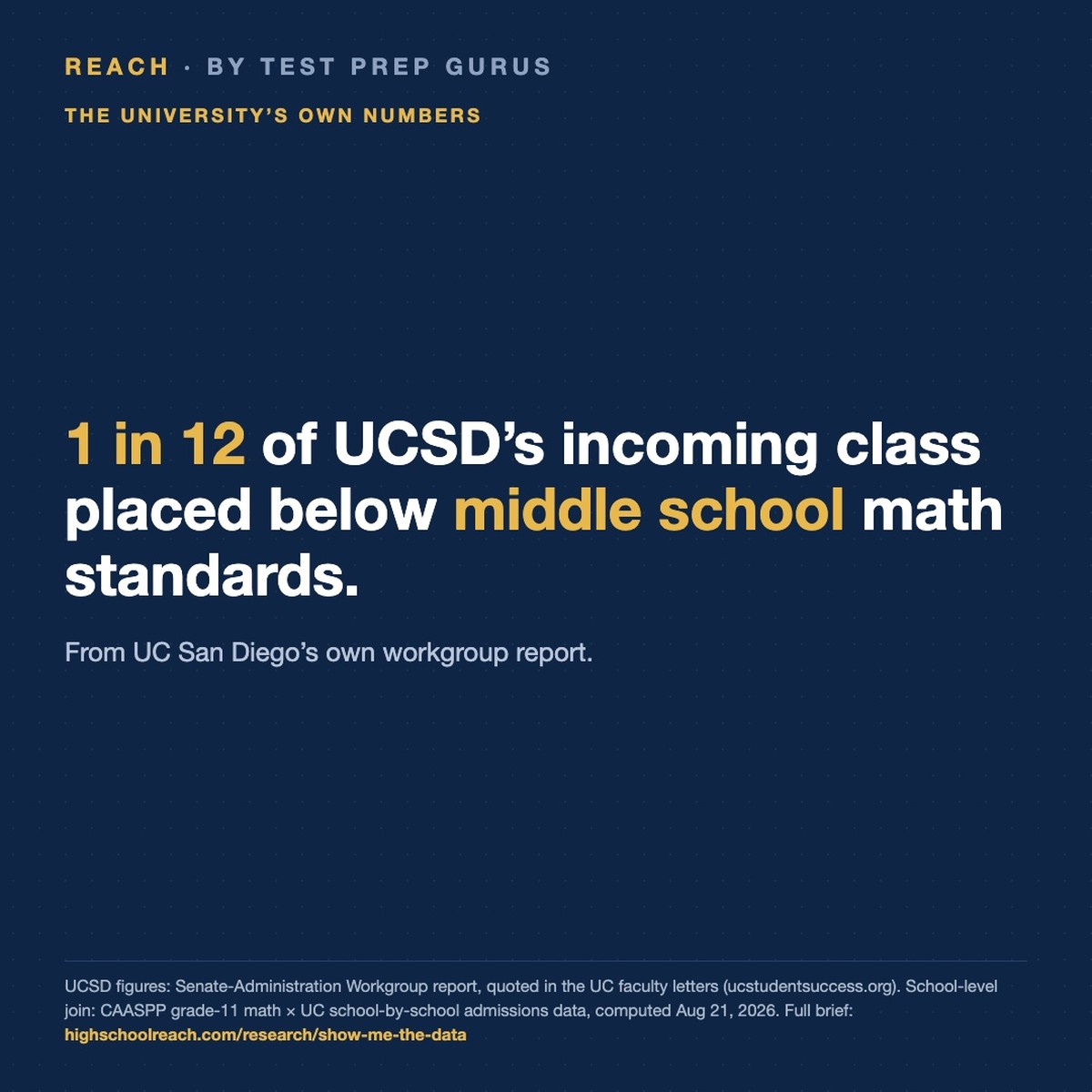
UC testing review · August 25, 2026