Rise Academy
San Jose · Santa Clara County · Religious-affiliated
Compare with peers
Most similar nearby schools
Kehillah Jewish High School → Apostles Lutheran School → Santa Clara High School → Khan Lab School → Granada Islamic School → Compare all similar →How Rise Academy compares for families
What families should know about Rise Academy.
- ▸ vs Similar SchoolsThe closest comparables nearby: Kehillah Jewish High School, Apostles Lutheran School, Santa Clara High School and 2 more. See the sidebar to compare side-by-side.
For Parents
Get alerts when Rise Academy's numbers change
New admissions results, enrollment shifts, test scores — a few alerts a year, no spam. Your email also saves your list across devices.
Objective, government-grade data — no school pays us for placement.
No SBAC data for private schools — and that's not the metric you want anyway
California's Smarter Balanced (CAASPP) assessment is administered by the state, by statute, to public & charter schools only. Private schools don't sit for it. That's why the SBAC card is missing on this profile — not a data gap on our side, a deliberate scope of the state's testing program.
For private schools, UC Reach is the stronger academic signal anyway. SBAC measures grade-11 inputs (proficiency on a state standard); UC Reach measures outputs (who actually got into the most selective UCs). For private-school families weighing tuition against college outcomes, the outputs are the relevant signal.
This school doesn't have UC outcomes data on file yet — we surface UCOP-published admits by sending HS, and not every private school appears in those records. The enrollment trend, stability, and other cards on this page are still primary-sourced for this school.
Enrollment trend & projection
If this trend holds (+12.2%/yr, Total enrollment)
At tuition of $ / student:
| Horizon | Projected Total enrollment | Change | Tuition impact / yr |
|---|---|---|---|
| 1 yr (2026) | ~252 | +27 | $0 |
| 3 yr (2028) | ~317 | +92 | $0 |
| 5 yr (2030) | ~399 | +174 | $0 |
Straight-line extrapolation of the recent annual rate — a what-if, not a forecast of intent. Default = a wide range — Jewish day $25k–35k, Lutheran/Christian $10k–18k. Edit the figure to match your school.
How does Rise Academy really compare on getting kids to college?
Unlock a head-to-head snapshot of Rise Academy against its 10 most similar nearby schools — matched on size, location, type, and religious orientation. See exactly where it stands on the college pipeline.
Your similar-school group includes
Kehillah Jewish High School · Apostles Lutheran School · Santa Clara High School · Khan Lab School · Granada Islamic School · Eastside College Prep School · +4 more
Private-school figures come from the California Private School Affidavit. Per CDE, inclusion in private-school data is not an evaluation, approval, or endorsement of a school.
GPA figures reflect 2024 — UC has not yet released applicant/admit GPA for 2025.
UC funnel — which kids are getting in at what GPA
Combining the school's applicant pool GPA, admit pool GPA, actual admit rate, and statewide CA admit rates by individual GPA band, we can read which GPA tiers tend to get in — and which don't.
| Campus | 4.00+ GPA | 3.70–3.99 GPA | 3.30–3.69 GPA | < 3.30 GPA |
|---|---|---|---|---|
| UC Davis | Strong shot | Real shot | Moderate | Filtered out |
The numbers behind it
| Campus | Applicant GPA | Admit GPA | Lift ⓘ | Admit rate | vs peer schools @ same GPA ⓘ |
|---|---|---|---|---|---|
| UC Davis | 3.92 | 4.15 | +0.23 | 35.7% | Peers +0.24 · matches |
Statewide CA admit rates by individual GPA band, 2024 (for reference)
| GPA band | UCB | UCLA | UCSD | UCSB | UCI | UCD |
|---|---|---|---|---|---|---|
| 4.00+ | 17.1% | 14.4% | 43.5% | 57.3% | 46.0% | 64.1% |
| 3.70–3.99 | 2.8% | 1.5% | 11.2% | 9.2% | 16.5% | 27.5% |
| 3.30–3.69 | 0.8% | 0.9% | 1.4% | 2.3% | 3.4% | 9.1% |
| 3.00–3.29 | 0.5% | 0.4% | 0.1% | 0.5% | 0.4% | 2.1% |
| < 3.00 | 0.6% | 0.2% | 0.2% | 0.5% | 0.3% | 0.6% |
Where Rise Academy sits vs. all California schools ⓘ
Overall, this school admits its UC applicants 10.4 points above what their GPAs predict (31.4% actual vs. 21.1% expected), based on 2024 data.
UC Outcomes Trend — 2020–2025
Class size from CDE grade 12 enrollment. Campus-level data: applicant and admit totals count a student once at EACH campus. A senior admitted to UCLA and UC San Diego adds 2 to the admit total, so the total can exceed the senior class — that is the metric working as defined, not an error. The admit RATE is unaffected: both its numerator and denominator are campus-level.
Campus Breakdown — 2025
| Campus | Applicants | Admits | Enrollees | Admit Rate | UC Reach Score | Yield | Avg GPA (App) '24 | Avg GPA (Adm) '24 |
|---|---|---|---|---|---|---|---|---|
| UC Berkeley → Elite | 10 | —† | —† | —† | —† | — | 3.95 | —† |
| UCLA → Elite | 7 | —† | —† | —† | —† | — | 4.09 | —† |
| UC San Diego → Selective | 7 | —† | —† | —† | —† | — | 4.12 | —† |
| UC Irvine → Selective | 7 | —† | —† | —† | —† | — | 3.92 | —† |
| UC Davis → | 9 | —† | —† | —† | —† | — | 3.92 | 4.15 |
What This Means
Related reading
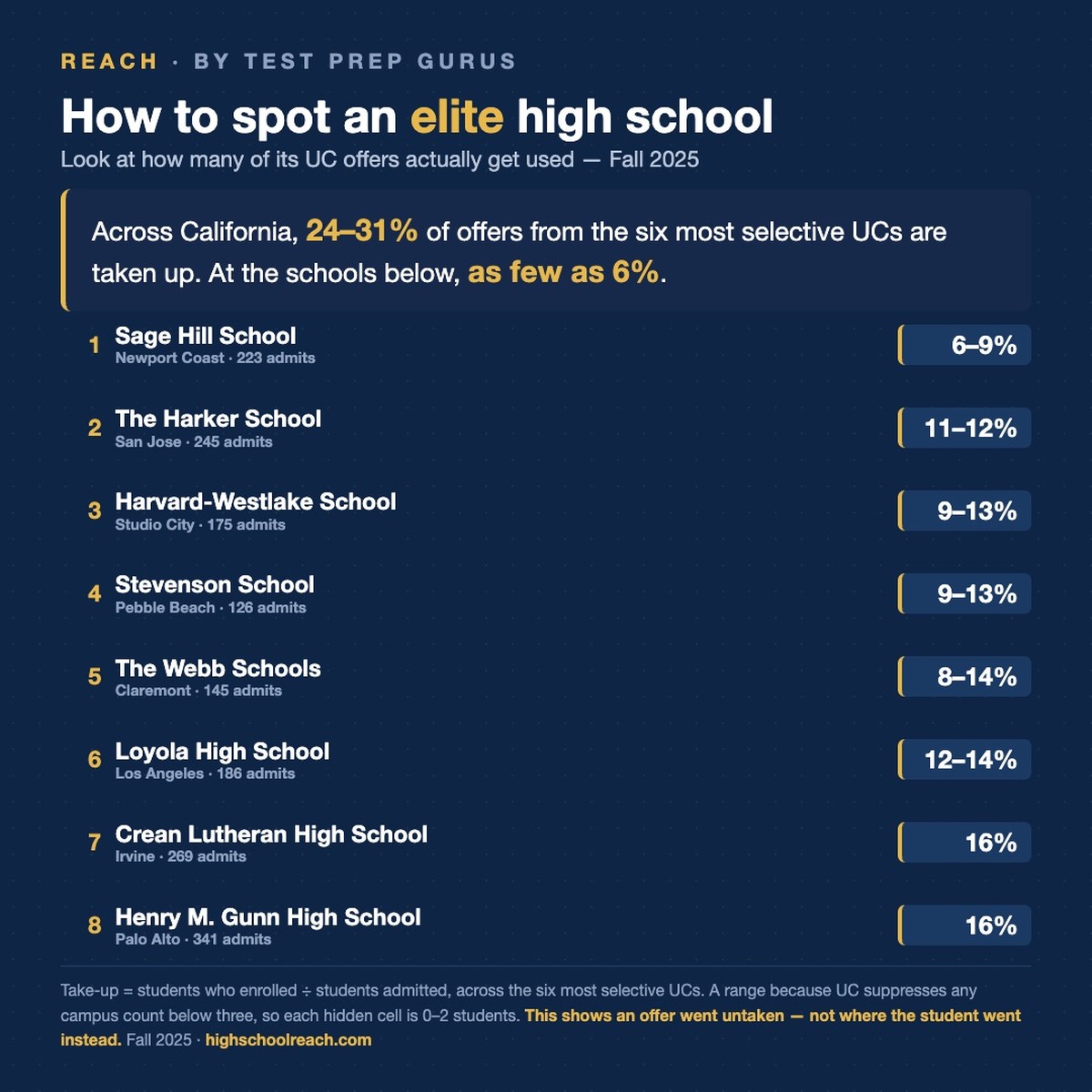
Behind the data · August 24, 2026
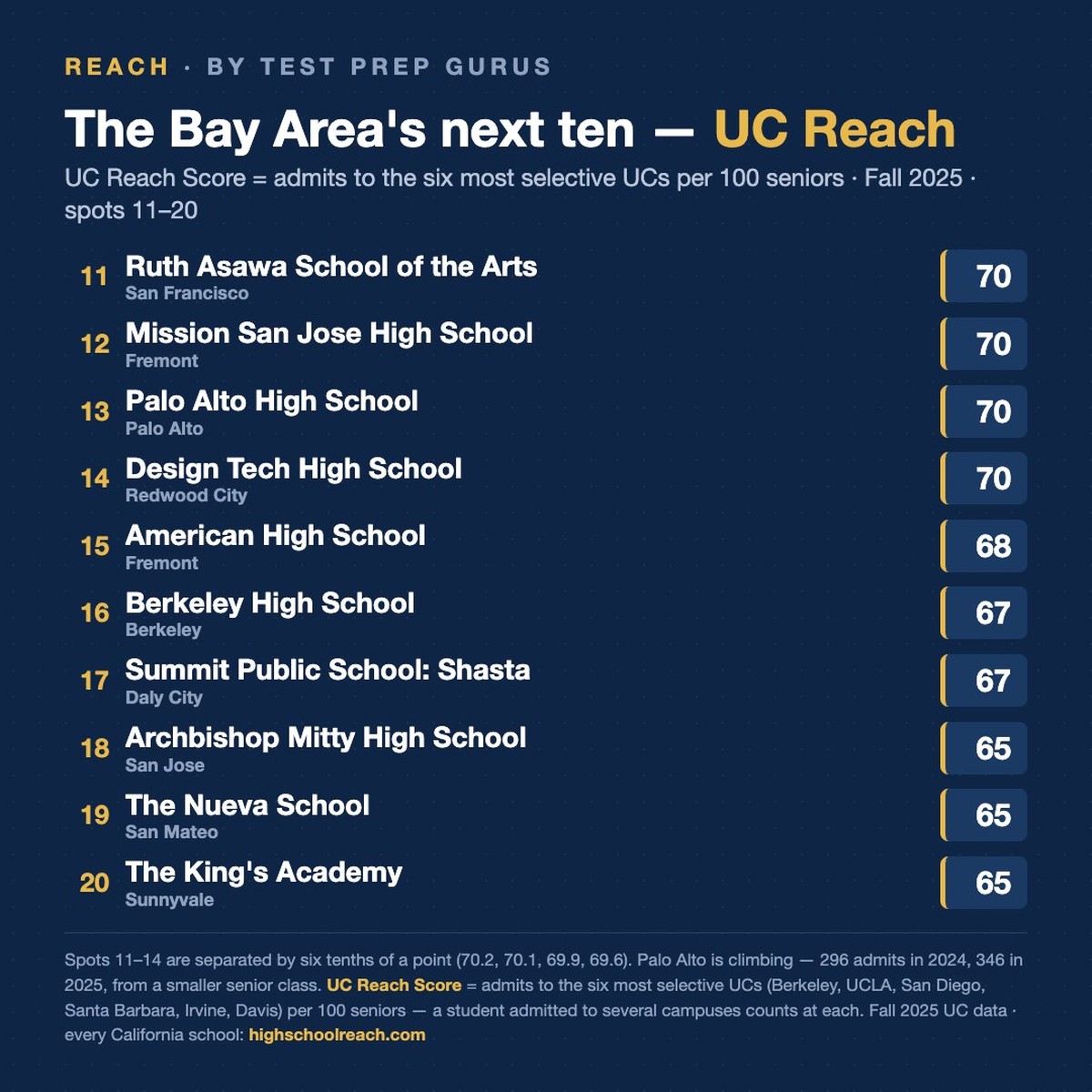
Bay Area · League table · August 19, 2026