Loyola High School
Los Angeles · Los Angeles County · Catholic religious-affiliated
Compare with peers
Most similar nearby schools
Notre Dame Academy → Campbell Hall → Village Christian High School → Rose and Alex Pilibos Armenian → Brentwood School → Compare all similar →A parent's read
- The UC pipeline here is real. 186 admissions to the top six UC campuses for a class of 299 seniors puts this school in roughly the top 5% of California high schools.
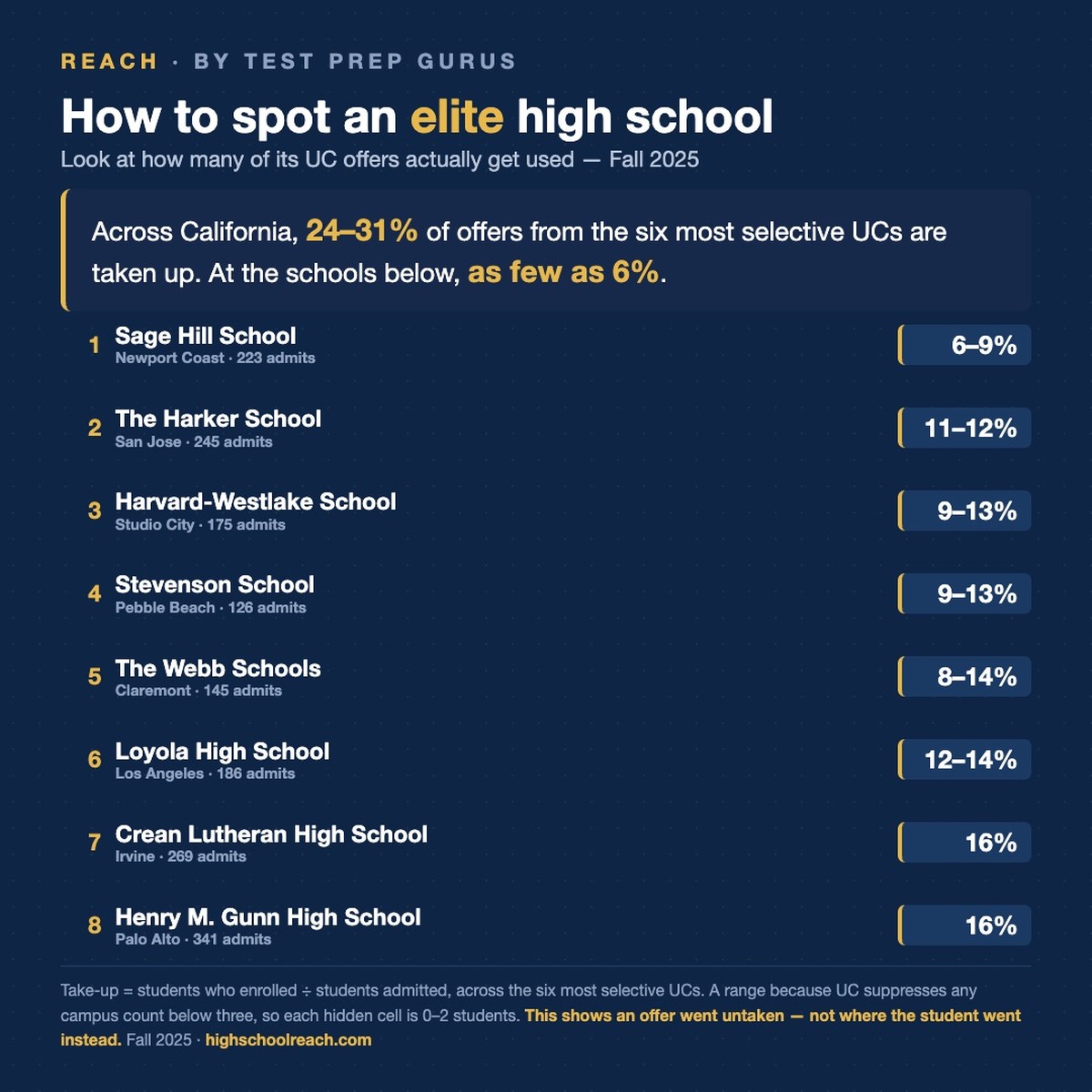
- Kids here turn down top UCs. Students admitted to Berkeley and UCLA from this school often enroll somewhere even more selective — a pattern seen only at schools whose graduates have elite options beyond the UC system.
- Elite admits are rare — here and everywhere. Berkeley and UCLA admitted 45 of this class's 823 UC applications. The strong middle campuses — San Diego, Santa Barbara, Irvine, Davis — are where most real UC outcomes happen.
- Students who test here average 1254 on the SAT. That's far above the national average of about 1030 — as published in the school's own profile.
- One question for any counselor: who should still test? Plenty of strong students skip the SAT/ACT now — but merit scholarships at dozens of colleges still key off scores. Ask how the school decides who should still sit for one.
Composed from this page's data — every claim is backed by a number in the sections below.
At a glance
- 26 AP courses offered (school profile)
- SAT avg 1254
- ACT avg 28.7
Composed from the school's own published profile (2024), and other public data. Full breakdowns below.
Where grads go — and what it costs & pays
UC admits by campus · Class of 2025
Getting in is step one. The cost above is the average aid-receiving family's net price — yours depends on whether you qualify for aid — and your child's odds depend on their GPA + scores. See your family's real numbers at these campuses:
Get my child's odds + our real costs →Sources: UC Office of the President (admits); IPEDS net price + College Scorecard 10-yr earnings (cost & payoff). Full campus-by-campus breakdown below.
How Loyola High School compares for families
Top-tier college outcomes for California families.
- ▸ StatewideUC Reach Score of 62 — 43 points above the California median of 19. Ahead of 95% of California high schools.
- ▸ Locally🎓 Top 10% in California on UC Reach — plus 1 more top-rank.
- ▸ vs Similar SchoolsBeats the peer median (UC Reach Score 62 vs a 42 median) across the 5 most similar nearby schools.
For Parents
Get alerts when Loyola High School's numbers change
New admissions results, enrollment shifts, test scores — a few alerts a year, no spam. Your email also saves your list across devices.
Objective, government-grade data — no school pays us for placement.
Their published matriculation list
Where their graduates enrolled
Loyola High School publishes where its graduates enrolled. What follows is copied from that document — 96 colleges, ordered by the number of students enrolled.
Years, as the document states them
2020-24
College · Students
and 66 more
These graduates went on to the colleges above.
Check your kid's odds at these colleges →We'll load the 10 colleges the class chose most often — add your name, email and your child's numbers and we'll see where your child lands at each.
Independently verified As published by Loyola High School — Loyola High School of Los Angeles -- School Profile 2024-25 ↗. Found at: p.4, 'Four-year Colleges Chosen by Graduates from 2020-24' (3-column numbered table).
No SBAC data for private schools — and that's not the metric you want anyway
California's Smarter Balanced (CAASPP) assessment is administered by the state, by statute, to public & charter schools only. Private schools don't sit for it. That's why the SBAC card is missing on this profile — not a data gap on our side, a deliberate scope of the state's testing program.
For private schools, UC Reach is the stronger academic signal anyway. SBAC measures grade-11 inputs (proficiency on a state standard); UC Reach measures outputs (who actually got into the most selective UCs). For private-school families weighing tuition against college outcomes, the outputs are the relevant signal.
Scroll up to the UC Reach card for Loyola High School's 2025 number, statewide percentile, and 5-year trend.
Enrollment trend & projection
If this trend holds (+0.4%/yr, Total enrollment)
At tuition of $ / student:
| Horizon | Projected Total enrollment | Change | Tuition impact / yr |
|---|---|---|---|
| 1 yr (2026) | ~1,294 | +5 | $0 |
| 3 yr (2028) | ~1,303 | +14 | $0 |
| 5 yr (2030) | ~1,312 | +23 | $0 |
Straight-line extrapolation of the recent annual rate — a what-if, not a forecast of intent. Default = a typical CA Catholic high school ($10k–18k). Edit the figure to match your school.
How does Loyola High School really compare on getting kids to college?
We've ranked it #2 of 11 most similar nearby schools on UC Reach. Unlock the full snapshot to see the head-to-head — who's ahead, by how much, and where it's heading.
Your similar-school group includes
Notre Dame Academy · Campbell Hall · Village Christian High School · Rose and Alex Pilibos Armenian · Brentwood School · Crossroads School · +4 more
Diocesan context — Archdiocese of Los Angeles
ArchdioceseLargest Catholic school system in the U.S. Archdiocese of Los Angeles is the canonical governance body for Catholic schools in this region — board policy, tuition guidance, and shared services typically originate here. Visit the diocesan website →
Financial figures aren't shown because Catholic (arch)dioceses don't file IRS Form 990 — they're covered by the USCCB Group Ruling (GEN 0928), which exempts dioceses, parishes, and parochial schools from individual filing. School counts above are hand-compiled from each diocese's published schools-department information.
Loyola High School sent 823 applications to the six most selective University of California campuses and 22.6% were admitted, producing a UC Reach Score of 62 (top-6 UC admits per 100 seniors, counting a student at each campus that admitted them) — 43 points above the California median of 19, higher than 95% of California high schools. The school produces 15.1 UCLA + UC Berkeley admits per 100 seniors.
Loyola High School earns admission to the six most selective UC campuses at a high rate (62 UC Reach Score), yet only about 29% of its Berkeley and UCLA admits go on to enroll there — well below the roughly 60% statewide. High admit rates paired with low enrollment at the very top UCs is the data signature of a class with options even more selective than the UCs — the kind of student who turns down Berkeley or UCLA only for a college even harder to get into.
An honest read of what the data holds: admissions and enrollment counts, not destinations. We don't track where any student enrolled, so this is a signature consistent with more-selective choices — not a claim about specific colleges. We measure Berkeley and UCLA together and against the statewide rate, so it isn't just a student picking a different UC (which would lower one campus's yield without leaving the system). Class of 2025, University of California Office of the President.
19
42
53
62
Higher than 95% of California high schools (1107 ranked, ≥50 seniors)
Loyola High School's UC Reach Score of 62 clears the statewide top-10% cutoff (53) — meaning roughly 62 top-6 UC admits per 100 seniors, well above what most California schools achieve.
In Los Angeles County — a competitive market where the median is already 25 — this still clears the county top-10% bar (56).
Against similar schools, Loyola High School stands out clearly — the peer-group median is 42.
For context, the elite tier (top 1%) clears 95 — a gap of 33 pp from where this school sits.
Overall, Loyola High School's UC Reach is higher than 95% of California high schools (1107 ranked).
Private-school figures come from the California Private School Affidavit. Per CDE, inclusion in private-school data is not an evaluation, approval, or endorsement of a school.
GPA figures reflect 2024 — UC has not yet released applicant/admit GPA for 2025.
UC funnel — which kids are getting in at what GPA
Combining the school's applicant pool GPA, admit pool GPA, actual admit rate, and statewide CA admit rates by individual GPA band, we can read which GPA tiers tend to get in — and which don't.
| Campus | 4.00+ GPA | 3.70–3.99 GPA | 3.30–3.69 GPA | < 3.30 GPA |
|---|---|---|---|---|
| UC Berkeley | Real shot | Long odds | Filtered out | Filtered out |
| UCLA | Real shot | Long odds | Filtered out | Filtered out |
| UC San Diego | Strong shot | Real shot | Long odds | Filtered out |
| UC Santa Barbara | Strong shot | Moderate | Long odds | Filtered out |
| UC Irvine | Strong shot | Real shot | Long odds | Filtered out |
| UC Davis | Strong shot | Real shot | Moderate | Filtered out |
The numbers behind it
| Campus | Applicant GPA | Admit GPA | Lift ⓘ | Admit rate | vs peer schools @ same GPA ⓘ |
|---|---|---|---|---|---|
| UC Berkeley | 3.97 | 4.18 | +0.21 | 16.0% | Peers +0.24 · matches |
| UCLA | 3.94 | 4.26 | +0.32 | 15.2% | Peers +0.29 · matches |
| UC San Diego | 3.91 | 4.27 | +0.36 | 15.8% | Peers +0.29 · steeper |
| UC Santa Barbara | 3.90 | 4.20 | +0.31 | 26.5% | Peers +0.31 · matches |
| UC Irvine | 3.85 | 4.20 | +0.35 | 23.6% | Peers +0.30 · steeper |
| UC Davis | 3.83 | 4.10 | +0.27 | 37.9% | Peers +0.28 · matches |
Statewide CA admit rates by individual GPA band, 2024 (for reference)
| GPA band | UCB | UCLA | UCSD | UCSB | UCI | UCD |
|---|---|---|---|---|---|---|
| 4.00+ | 17.1% | 14.4% | 43.5% | 57.3% | 46.0% | 64.1% |
| 3.70–3.99 | 2.8% | 1.5% | 11.2% | 9.2% | 16.5% | 27.5% |
| 3.30–3.69 | 0.8% | 0.9% | 1.4% | 2.3% | 3.4% | 9.1% |
| 3.00–3.29 | 0.5% | 0.4% | 0.1% | 0.5% | 0.4% | 2.1% |
| < 3.00 | 0.6% | 0.2% | 0.2% | 0.5% | 0.3% | 0.6% |
Where Loyola High School sits vs. all California schools ⓘ
Overall, this school admits its UC applicants in line with what their GPAs predict (21.2% actual vs. 20.3% expected), based on 2024 data.
UC Outcomes Trend — 2024–2025
Class size from CDE grade 12 enrollment. Campus-level data: applicant and admit totals count a student once at EACH campus. A senior admitted to UCLA and UC San Diego adds 2 to the admit total, so the total can exceed the senior class — that is the metric working as defined, not an error. The admit RATE is unaffected: both its numerator and denominator are campus-level.
Campus Breakdown — 2025
| Campus | Applicants | Admits | Enrollees | Admit Rate | UC Reach Score | Yield | Avg GPA (App) '24 | Avg GPA (Adm) '24 |
|---|---|---|---|---|---|---|---|---|
| UC Berkeley → Elite | 151 | 25 | 7 | 16.6% | 8 | 28.0% | 3.97 | 4.18 |
| UCLA → Elite | 179 | 20 | 6 | 11.2% | 7 | 30.0% | 3.94 | 4.26 |
| UC San Diego → Selective | 137 | 34 | 3 | 24.8% | 11 | 8.8% | 3.91 | 4.27 |
| UC Santa Barbara → Selective | 155 | 39 | —† | 25.2% | 13 | — | 3.90 | 4.20 |
| UC Irvine → Selective | 104 | 26 | —† | 25.0% | 9 | — | 3.85 | 4.20 |
| UC Davis → | 97 | 42 | 6 | 43.3% | 14 | 14.3% | 3.83 | 4.10 |
What This Means
Related reading
Behind the data · August 24, 2026
UC testing review · August 25, 2026